
Chapter 01
What is Legion?
The big picture: peer-to-peer, your data, your control — and the four layers of privacy.
The problem with “the cloud”
Today, when you use a voice assistant, an AI chat, or a personal app, the work is usually done on a server that belongs to some company. You send your data to them, they process it, and send back a result.
This works fine — until it doesn't. What if that server goes down? What if the company changes its pricing? What if it gets hacked? What if the company decides to sell your data?
All of these are real risks. And there's no way around them because this is how the “client-server” model works: you are the client, they are the server, and you have to trust them.
The Legion way: your devices, your rules
Legion takes a different approach. Instead of sending your data to a company's server, your data stays on devices you control. And those devices — your phone, a Raspberry Pi, a desktop computer, a server you rent — talk to each other directly. No middleman.
Here's what that looks like in practice:
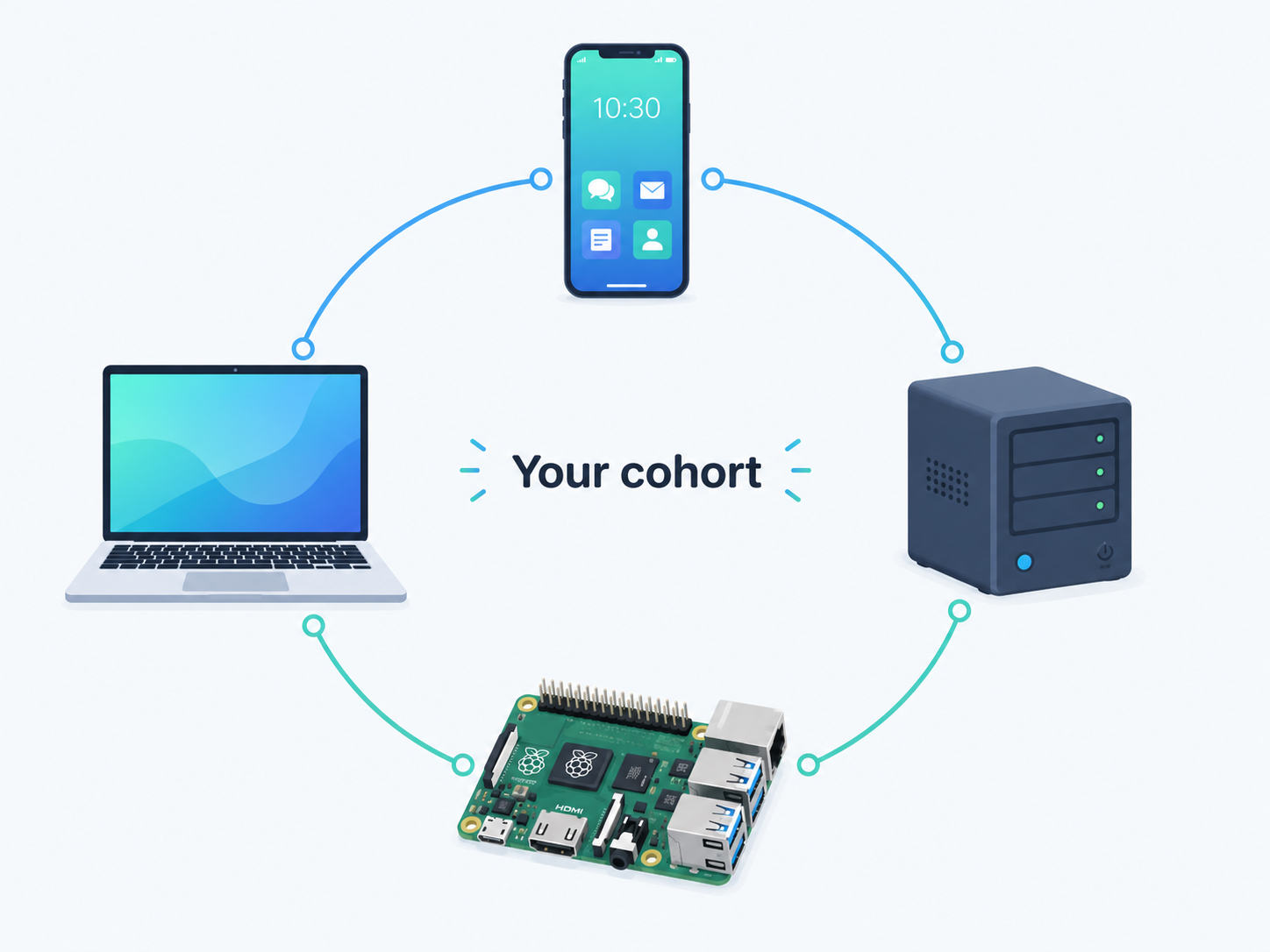
Every device in this group is called a node. Every node has its own identity, its own capabilities (what it can do), and its own voice in the group. They all share a common goal defined by their owner — and that's you.
A quick analogy
Think of Legion like a neighborhood team.
In the old model (client-server), everyone calls one big call center. The call center decides everything. If the call center closes, nobody can get help.
In the Legion model, neighbors help each other. If you need someone to translate a message, someone in the neighborhood who speaks that language steps in. If you need storage, someone with extra space lends it. If you need a strong calculator (like an AI model), someone with a powerful computer handles it.
What makes Legion different
| Old model | Legion model |
|---|---|
| One server does everything | Many small devices each do a little |
| Data lives on company servers | Data stays on your devices |
| If the server dies, you're stuck | If one device dies, others pick up |
| You trust the company with your data | You control who sees your data |
| “I'm sorry, our service is discontinued” | Your network works forever, as long as you have devices |
The four layers of privacy (explained simply)
Legion organizes data into four levels of privacy, like an onion:
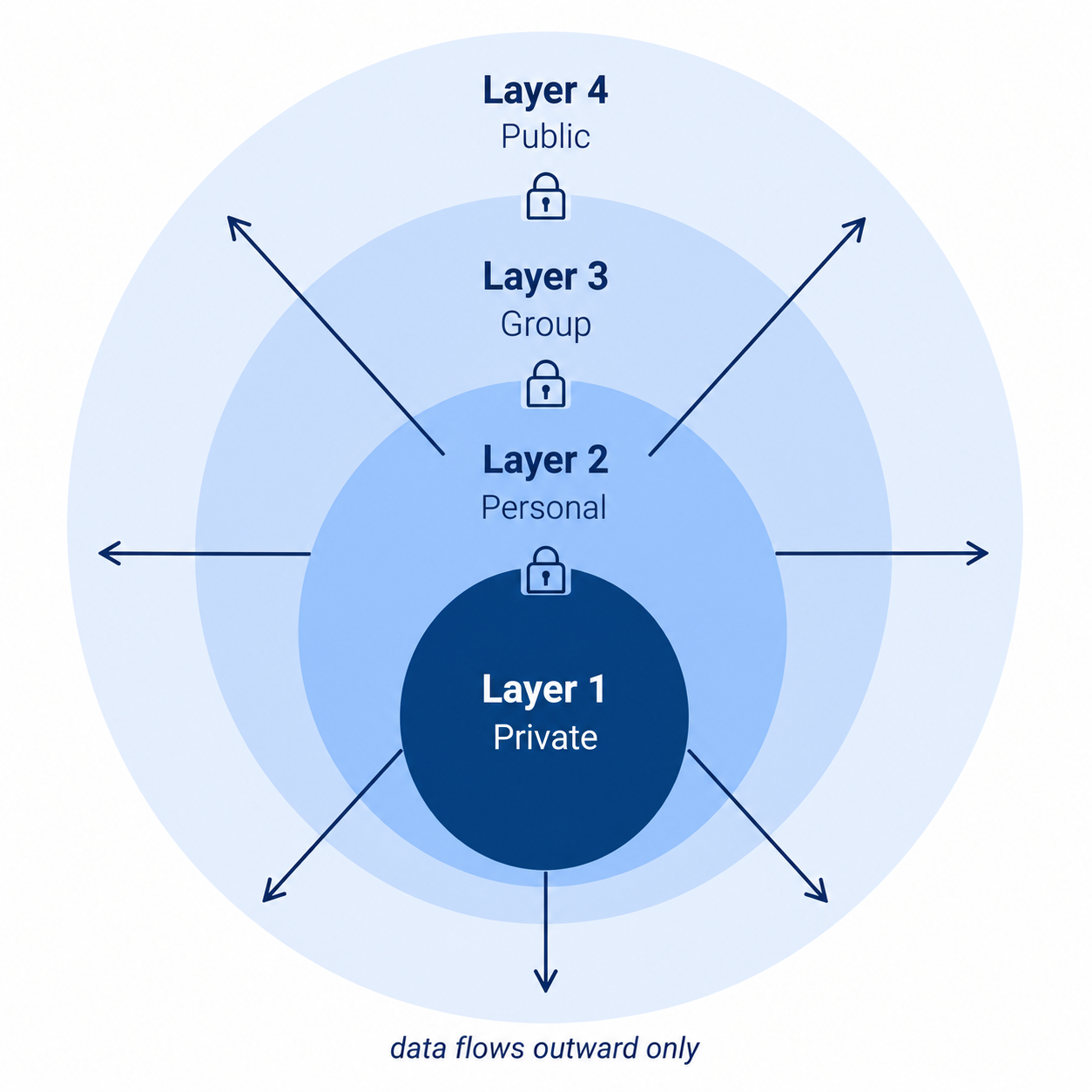
- Layer 1 — Private (your vault): Only you can access this. Think of it as your personal diary. Even the other devices in your network can't read it.
- Layer 2 — Personal (your inner circle): Your closest devices can see this. Like sharing a family photo album with just your phone and laptop.
- Layer 3 — Group (your team): Shared among your whole group of devices. Like a shared calendar that everyone in your cohort uses.
- Layer 4 — Public (the world): Data that can be shared openly. Like a public website.
Data can flow outward (from private to public) but never inward (from public to private) without your explicit permission. Once data gets dropped to a lower tier, it can never climb back up — like a ball rolling down a hill, it doesn't go back up on its own.
What Legion is NOT
It's just as important to know what Legion is not:
- Not a cryptocurrency. There's no coin, no mining, no blockchain.
- Not a social network. It doesn't connect strangers. It connects your devices.
- Not a replacement for the internet. It runs on the internet (or without it — it works offline too).
- Not “cloud computing”. There is no cloud. You are the cloud — your own devices.
What comes next
If you're curious about how this looks in real life, read A day in the life of Legion to see a complete story. If you want to understand the core ideas that guide every decision in Legion, read The big ideas.